Total Pageviews

Showing posts with label #INTERNAL SECURITY. Show all posts

Wednesday, 1 April 2026

An Invisible Financial Architecture of Shadow Warfare In India


For nearly three decades, an unobserved financial system operated behind the formal global banking network, moving billions of dollars across borders without meaningful records, oversight, or accountability. The Karachi-based hawala network Khanani & Kalia International (K&K) served as a central operational hub, enabling researchers to examine how transnational organized crime can fund terrorism while embedding its activities within state-linked secret channels.

The Architecture of a Shadow Economy

In the 1980s, the brothers Javed and Altaf Khanani established K&K as an informal remittance service that later evolved into a major non-traditional financial institution. At its peak, the network allegedly handled roughly 40% of Pakistan’s unrecorded foreign-exchange activity, and U.S. Treasury reporting linked it to an estimated $16 billion in illicit transfers each year.

K&K operated through locations in Dubai, Hong Kong, London, and New York, relying on hawala’s core mechanism: value could be shifted through trust-based ledger adjustments rather than by moving physical cash. This structure made the network’s activity harder to detect through conventional transaction monitoring systems.

The client ecosystem associated with K&K also reflects the convergence of mature illicit finance networks. Reported connections include Colombian and Afghan narcotics syndicates, extremist organizations such as Lashkar-e Taiba and Jaish-e-Mohammed, and other designated groups including Al-Qaeda and the Taliban, as well as D-Company, attributed to Dawood Ibrahim. Intelligence assessments further alleged that the network may have been used by Pakistan’s Inter-Services Intelligence (ISI) to support covert operations, including financing insurgent activities in Jammu & Kashmir—illustrating how state and non-state actors can rely on shared illicit financial infrastructure.

Counterfeit Currency as Economic Warfare

A key strategic component attributed to the Khanani operation was its alleged role in Project Karachi, intended to flood Indian markets with high-quality counterfeit currency. Between 2005 and 2016, an estimated ₹1,500–₹2,000 crore of fake ₹500 and ₹1,000 notes reportedly entered Indian circulation each year. Distribution networks operating from Dubai and Nepal, and also involving Bangladesh, were said to have driven this flow.

Detection rates allegedly remained below 10% because counterfeiters replicated security features—including watermarks, security threads, and paper quality—with near-perfect accuracy. The logic was deliberately economic: currency destabilization functions like a low-cost form of strategic pressure, producing high systemic disruption. Reported consequences included inflationary pressure, reduced institutional trust, and the continued operation of terror financing channels—potentially including payments routed through stone-pelters and sleeper networks—thereby advancing a kind of systemic degradation that conventional military or diplomatic tools struggle to counter.

The broader debate around De La Rue (the British currency-security firm) remains unresolved. The Reserve Bank of India terminated its contract with De La Rue in 2010 due to quality issues, then restored the contract in 2012. Whether changes in Pakistan’s counterfeit capabilities correlated with these contractual shifts remains under scrutiny, including a CBI investigation involving a former Finance Secretary.

Demonetisation as Strategic Disruption

On 8 November 2016, India’s demonetisation of ₹500 and ₹1,000 notes delivered a structurally decisive blow to the shadow ecosystem. Whatever its domestic economic rationale, the policy action abruptly invalidated the denominations central to both counterfeit circulation and hawala settlement.

As a result, an estimated ₹1,500–₹2,000 crore in fake notes was effectively neutralized, terror-financing channels dependent on those denominations were disrupted, and hawala operators faced significant operational strain—particularly because their mechanisms for converting and recycling value were tied to those specific notes. Reported declines in stone-pelting incidents in Kashmir—about a 43% reduction in the following year—suggest operational impact, though the sources and causality remain disputed.

In this episode, what decades of coordinated law enforcement and bilateral diplomacy had failed to achieve was accomplished through a single monetary-policy instrument, albeit with serious domestic costs. The episode also raises an essential policy question: Under what conditions do macroeconomic interventions become more effective counter–terror financing tools than conventional investigative or regulatory approaches?

The Lifecycle and Architecture of Dirty Money

Terror financing does not occur as a single event; it moves through multiple suspicious transactions that create pathways designed to evade detection until late-stage safeguards are triggered. The Khanani case demonstrates this principle through a system architecture that functions as its primary protective mechanism.

In broad terms, illicit operations can begin with transactions that initially appear lawful, such as a cash deposit, then proceed through cross-border wire transfers, and later culminate in asset purchases, including property acquisition. As captured in the referenced lifecycle model, transaction-level checks alone are necessary but insufficient. Effective disruption requires multi-agency visibility, including cross-department analytics to uncover hidden connections; trade reconciliation to identify systemic fraud; and cross-channel fusion to connect banking activity with non-banking legal and contractual relationships, trade movements, and digital transactions.

Ultimately, counter–terror financing requires more than locating isolated evidence. Investigators need comprehensive understanding of the full operational system—its components, pathways, and relationships—so that the investigation can follow the correct line of inquiry from the start.

The Lessons of Shadow Finance

The Khanani case calls for more than retrospective analysis. It shows that illicit networks build durability not primarily through sheer volume, but through structural complexity: fewer transactions, larger values, and deeper layering that reduce the probability of detection unless intelligence is applied at the network level across jurisdictions simultaneously.

The 2015 U.S. Treasury designation of Altaf Khanani and his later conviction in 2017 confirmed the network’s scale, but also exposed how enforcement often operates with delayed impact—reflecting the latency of reactive frameworks. As energy crises, sanctions regimes, and geopolitical shocks continue to produce the opacity illicit finance requires, the Khanani precedent remains urgent: shadow economies do not merely exploit instability—they are engineered to scale within it.

Thursday, 15 May 2025

India Needs Its Own BBC: The Case for a Global Public Broadcaster Post-Pahalgam A Historic Moment for Action

On May 7, 2025, India launched “Operation Sindoor,” a strategic military offensive aimed at dismantling terrorist strongholds in Pakistan and Pakistan-occupied Kashmir. This operation was a direct response to the tragic Pahalgam terrorist attack, which occurred in April 2025 and claimed 26 innocent lives. While the military campaign marked a significant victory against terrorism and its sponsors, it exposed a critical struggle for narrative control, highlighting a significant flaw in India’s global outreach.

The War of Narratives: India’s Vulnerability

The international media coverage of the recent India-Pakistan hostilities has often been characterized by speculative narratives and unverified claims. This reporting has frequently undermined India’s documented military successes while amplifying Pakistan’s unsubstantiated assertions. Despite India’s armed forces presenting concrete evidence of targeted strikes, many outlets hastily framed the conflict as a “stalemate,” adhering to a superficial “both sides” narrative.

For instance, Al Jazeera falsely reported the capture of an Indian female pilot, a claim quickly debunked by officials from both nations. Additionally, the Middle East Eye circulated unverified videos suggesting India sought third-party mediation, contradicting Pakistan’s silence on India’s claim that it requested a ceasefire after sustaining heavy losses.

Western media often echoed Pakistan’s claims, such as the unverified downing of “five Indian jets.” CNN cited an anonymous French official to validate one jet’s loss, while The National Interest controversially declared an “unambiguous Pakistani victory” based on dubious assertions and exaggerated praise for Chinese missile technology. This rush to judgment overlooked India’s tactical triumphs, such as the Navy's strategic pressure on Karachi, which was pivotal in prompting Pakistan’s ceasefire appeal.

The Need for a State Public Broadcaster

India must establish its own authoritative, state-supported international broadcaster to combat hostile narratives and assert its voice on the global stage. This broadcaster should serve as a credible and culturally resonant voice for the nation, focusing on three core mandates: countering misinformation, advancing strategic interests, and projecting India’s civilizational ethos.

Unlike existing platforms, this new broadcaster should combine the reach and trustworthiness of traditional media with the agility of digital platforms. It should operate under an expanded Prasar Bharati framework but function as a legally autonomous entity with limited political interference.

To ensure stable financing, it should be primarily funded by a government-allocated, non-lapsable corpus fund, avoiding the budgetary uncertainties that have plagued other public broadcasters. Additionally, public-private partnerships could help reduce reliance on taxpayer money, with collaborations for thematic programming and initiatives.

Engaging Content and Global Reach

The broadcaster can revolutionize India’s global media presence by prioritizing dynamic, audience-centric content. News and current affairs would form the backbone, supported by hyperlocal bureaus producing regional bulletins. Flagship debate programs with globally recognized moderators would enhance credibility.

High-production documentaries showcasing lesser-known traditions and digital formats like reels and podcasts would engage younger audiences. This approach would enable India to capture hearts and minds effectively.

Conclusion: The Urgency of Action

The conflict with Pakistan highlights a crucial truth: in today’s interconnected world, controlling one’s narrative is as vital as defending borders. India’s lack of global media influence risks its stories being told by others. As India rises as a geopolitical and economic power, it must wield the megaphone of soft power with equal vigor as its diplomatic and economic tools.

The cost of inaction is steep, as it allows biased portrayals by Western media to prevail. Now is the time for India to invest in a Global Public Broadcaster, transforming its "soft power deficit" into a cornerstone of global influence. In the battle for hearts and minds, silence is not an option. India must speak, and the world must listen

A Historic Moment for Action

On May 7, 2025, India launched “Operation Sindoor,” a strategic military offensive aimed at dismantling terrorist strongholds in Pakistan and Pakistan-occupied Kashmir. This operation was a direct response to the tragic Pahalgam terrorist attack, which occurred in April 2025 and claimed 26 innocent lives. While the military campaign marked a significant victory against terrorism and its sponsors, it exposed a critical struggle for narrative control, highlighting a significant flaw in India’s global outreach.

The War of Narratives: India’s Vulnerability

The international media coverage of the recent India-Pakistan hostilities has often been characterized by speculative narratives and unverified claims. This reporting has frequently undermined India’s documented military successes while amplifying Pakistan’s unsubstantiated assertions. Despite India’s armed forces presenting concrete evidence of targeted strikes, many outlets hastily framed the conflict as a “stalemate,” adhering to a superficial “both sides” narrative.

For instance, Al Jazeera falsely reported the capture of an Indian female pilot, a claim quickly debunked by officials from both nations. Additionally, the Middle East Eye circulated unverified videos suggesting India sought third-party mediation, contradicting Pakistan’s silence on India’s claim that it requested a ceasefire after sustaining heavy losses.

Western media often echoed Pakistan’s claims, such as the unverified downing of “five Indian jets.” CNN cited an anonymous French official to validate one jet’s loss, while The National Interest controversially declared an “unambiguous Pakistani victory” based on dubious assertions and exaggerated praise for Chinese missile technology. This rush to judgment overlooked India’s tactical triumphs, such as the Navy's strategic pressure on Karachi, which was pivotal in prompting Pakistan’s ceasefire appeal.

The Need for a State Public Broadcaster

India must establish its own authoritative, state-supported international broadcaster to combat hostile narratives and assert its voice on the global stage. This broadcaster should serve as a credible and culturally resonant voice for the nation, focusing on three core mandates: countering misinformation, advancing strategic interests, and projecting India’s civilizational ethos.

Unlike existing platforms, this new broadcaster should combine the reach and trustworthiness of traditional media with the agility of digital platforms. It should operate under an expanded Prasar Bharati framework but function as a legally autonomous entity with limited political interference.

To ensure stable financing, it should be primarily funded by a government-allocated, non-lapsable corpus fund, avoiding the budgetary uncertainties that have plagued other public broadcasters. Additionally, public-private partnerships could help reduce reliance on taxpayer money, with collaborations for thematic programming and initiatives.

Engaging Content and Global Reach

The broadcaster can revolutionize India’s global media presence by prioritizing dynamic, audience-centric content. News and current affairs would form the backbone, supported by hyperlocal bureaus producing regional bulletins. Flagship debate programs with globally recognized moderators would enhance credibility.

High-production documentaries showcasing lesser-known traditions and digital formats like reels and podcasts would engage younger audiences. This approach would enable India to capture hearts and minds effectively.

Conclusion: The Urgency of Action

The conflict with Pakistan highlights a crucial truth: in today’s interconnected world, controlling one’s narrative is as vital as defending borders. India’s lack of global media influence risks its stories being told by others. As India rises as a geopolitical and economic power, it must wield the megaphone of soft power with equal vigor as its diplomatic and economic tools.

The cost of inaction is steep, as it allows biased portrayals by Western media to prevail. Now is the time for India to invest in a Global Public Broadcaster, transforming its "soft power deficit" into a cornerstone of global influence. In the battle for hearts and minds, silence is not an option. India must speak, and the world must listen

Sunday, 30 June 2024

Why India Needs an Internal Security Plan for The Next Five Years By Prakash Singh The writer was formerly Director General of BSF, DGP UP and DGP Assam

 A country projects its strength at the international level in direct proportion to its internal cohesion, its ability to resolve the differences within and not have any swamps where terrorists or extremists of any shade can breed. The dust of elections has settled. The NDA government is firmly in the saddle. The Prime Minister already has a formidable list of achievements to his credit. At the international level, India has prestige, which it probably has never had since Independence. Our economy is on a high trajectory. China has, for the first time, realised that it can no longer bully India and that, beyond a point, India would not shrink from a bloody confrontation. The government should have a well-orchestrated plan for the next five years. On internal security, the following nine points should merit serious attention. One - internal security doctrine Ideally, the country should have a national security doctrine (NSD). The National Security Advisory Board has, from time to time, worked on it and prepared drafts. For inexplicable reasons, those were never approved. All significant powers have an NSD through which they describe the internal and external challenges facing the country and prescribe the policies for dealing with them. If there are any problems in developing the NSD, its internal security component at least, which is simpler, could be worked out. There is too much adhocism in dealing with the internal security challenges, especially when there is a change of government. Two - Internal Security Ministry The Ministry of Home Affairs has become much too heavy and therefore unwieldy. Internal security matters, which demand immediate attention, quite often do not get the prompt and thorough attention they deserve. It is high time that a young, junior minister working in the MHA is given independent charge of internal security. Rajesh Pilot showed what a difference such an arrangement could make.

Thursday, 21 March 2024

Countering External & Internal Security Challenges To Indian National Security

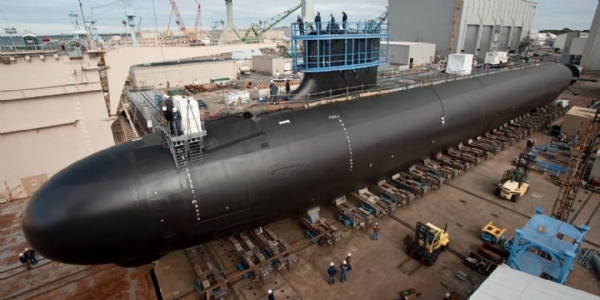
 U.S. cuts key submarine order for 2025 amid shipbuilding jam

 
Pentagon's 0.9% budget growth pales in comparison to China's 7.2%
 
NB Security Scan 78 
 
 
The U.S. Department of Defense will order just one Virginia-class nuclear-powered attack submarine in fiscal 2025, a drop from the two-per-year pace of recent years.
 
The decrease, announced Monday, reflects U.S. shipbuilding bottlenecks. The two private shipyards that produce the Virginia class -- General Dynamics and Huntington Ingalls Industries -- face mounting backlogs due to limited capacity and personnel shortages.
 
The decision also highlights the Pentagon's dilemma of having to counter a massive defense buildup by China while under fiscal limitations.
 
The Pentagon's total fiscal 2025 budget request was $849.8 billion, a 0.9% increase on the year. China's annual defense budget for 2024, revealed earlier this month, grew by 7.2% to 1.67 trillion yuan ($233 billion).
 

Shipbuilding: the new battleground in the US-China trade war

 
Labour unions are urging the Biden administration to investigate China’s dominance of naval engineering, potentially inflaming Sino-American tensions.
 
The software at the center of debate over Chinese cyber threat inside the biggest ports in US
 
80% of the “ship-to-shore” cranes moving trade at U.S. ports are made in China and that the U.S. government has claimed in recent testimony “use Chinese software.”
 
But port executives interviewed by CNBC say that operating software on these cranes comes from Germany, Japan and other countries outside the People’s Republic of China.
 
More than half of the roughly 200 Chinese cranes at U.S. ports have been inspected by U.S. Coast Guard, with Rear Adm. Jay Vann, commander of Coast Guard’s Cyber Command, saying the equipment could be “vulnerable to exploitation.
 
Countering External & Internal Security Challenges
 
Indian tourists shun Maldives
 
A full-blown backlash was directed at the Maldives following derogatory remarks against India and Prime Minister Narendra Modi on social media by three Maldivian officials after Modi posted photos and video of the pristine Lakshadweep Islands on India's west coast on January 6 on his X handle.
 
According to the Maldives Tourism Ministry statistics, over 17 lakh tourists visited the island nation in 2023, out of which more than 2,09,198 visitors were Indians followed by Russians (2,09,146) and China (1,87,118). The number of Indian visitors was more than 2.4 lakh in 2022 while over 2.11 lakh Indians flew to the Maldives in 2021.
 
India occupied the sixth spot in tourist arrivals in 2024, the Ministry's statistics showed, compared to the consistent first spot since 2020 with Indian tourists visiting the island nation even during the pandemic time.
 
Till about 10 days ago, the Ministry data showed that tourist arrivals from India as of March 2 was 27,224, which is a 33 per cent decline compared to last year when the corresponding number stood at 41,224.
 
Japan eyes export of stealth naval ship antennas to India
 
Possible sale comes as New Delhi aims to lower reliance on Russian arms
 
The Japanese government is considering exporting naval ship communication antennas to India, Nikkei has learned.
 
The NORA-50 antenna, dubbed "UNICORN," was jointly developed by a group of Japanese companies that includes electronics maker NEC and Yokohama Rubber. Sources close to the matter said the government is still deciding how many antennas will be sold as well as the cost of the contact.
 
If the deal goes through, it will be just the second time Japan has exported defense equipment since it lifted a ban on such transfers in 2014. The first came last year when radar systems were exported to the Philippines.
 
The antenna deal would expand Japan-India security relations to defense equipment, which in turn would likely strengthen deterrence in the Indo-Pacific region.
 
Japan hopes the deal will also lead to India decreasing its heavy reliance on Russia for defense equipment.
 
'Divya Putri' Sheena Rani: Meet the brain behind India's deadliest weapon Agni-5 MIRV
 
India has achieved a significant milestone in defense with the successful test of the Agni-5 missile, equipped with Multiple Independently Targetable Re-entry Vehicle (MIRV) technology. R Sheena Rani, known as 'Divya Putri' (Divine Daughter), leads the project, showcasing her expertise in missile technology. Her dedication has been crucial in developing the Agni-5, enhancing India's strategic deterrence capabilities. Inspired by Dr APJ Abdul Kalam, Rani's leadership underscores India's technological advancement in missile technology, ensuring national security and global recognition.
 
Defence Minister Rajnath Singh approves expansion of National Cadet Corps by adding 3 lakh cadet vacancies
 
Rajnath Singh has approved the expansion of the National Cadet Corps (NCC) by adding three lakh cadet vacancies, in response to increasing demand for NCC enrolment from educational institutions nationwide. The NCC, established in 1948 with 20,000 cadets, will now have a sanctioned strength of 20 lakh cadets, making it the world's largest uniformed youth organization. This expansion, aligned with the National Education Policy 2020, aims to empower youth as future leaders. The plan includes distributing vacancies evenly across all States and Union Territories, establishing new Group Headquarters, and adding new NCC units.
 
First crash in 23 years: Tejas fighter jet
 
An Indian Air Force's LCA Tejas aircraft crashed near Rajasthan's Jaisalmer, with the pilot safely ejecting. This marks the first crash involving the jet since its inaugural flight 23 years ago. The Tejas is a domestically developed supersonic aircraft used by the Indian military, succeeding the ageing Mig 21 fighter jets. It is the lightest and smallest multi-role supersonic fighter aircraft in its category, designed to accommodate various types of weaponry. The crash in Jaisalmer is a significant event in the aircraft's history, which began with its first test flight in 2001.
 
Can India forge a 3-way partnership with Japan, South Korea to ‘counter China’s actions’?
 
India’s deepening security ties with both nations highlights its growing ability to act as a go-between as Chinese influence in the Indo-Pacific grows, analysts say
 
Such a grouping would likely act as a complementary force to the Quad bloc rather than against it, observers suggest.
 
India ramps up campaign to position India as alternative to China
 
Prime Minister Narendra Modi’s government is taking advantage of India’s rising appeal as the world’s fastest-growing major economy and an alternative to China for global supply chains to clinch a number of free trade agreements (FTAs). India expects its deals with countries from the U.K. to Australia to help boost its manufacturing and soak up the tens of millions of young people entering the workforce in the years ahead.
 
The latest, and among the most ambitious, was a trade and investment pact signed with four European countries, including Switzerland and Norway, on March 10. It signalled India’s readiness to take on commitments in areas such as labor, environment and sustainability, and gender — topics it had shied away from in the past. It was also the first time India secured an investment commitment — of $100 billion over 15 years — in such a deal.
 
India has now signed four FTAs in quick succession since 2021 after a gap of about nine years where no agreements were inked. The latest pact with the European bloc of countries, known as the European Free Trade Association (EFTA), was hailed by Modi and comes just weeks before elections in which he’s seeking to extend his decade in power.
 

Tuesday, 12 March 2024

Countering iNDIAN External & Internal Security Challenges


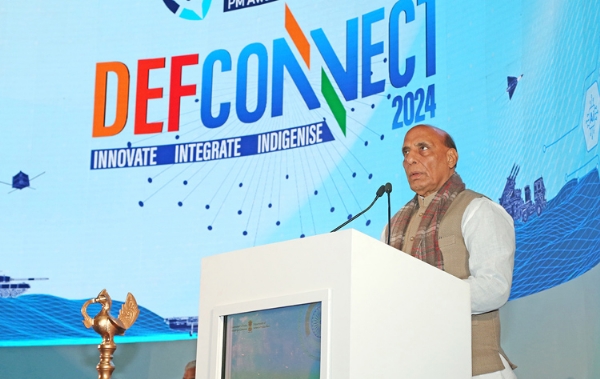
DefConnect 2024: Rajnath Singh launches ADITI scheme, allocates ₹750 crore to promote innovation in Defence Technologies
 
 
NB Security Scan 77 
 
 
The Ministry of Defence (MoD) announces ₹750 crore corpus under ADITI scheme to boost innovation in defence tech. The scheme aims to develop 30 critical technologies by 2025-26 and bridge gaps in Armed Forces' capabilities. Start-ups can receive up to ₹25 crore for research. Defence Minister Rajnath Singh emphasizes self-reliance in defence production and transforming India into a knowledge society. The scheme marks an expansion of iDEX with iDEX Prime offering increased assistance. ADITI underscores the government's commitment to innovation and self-reliance in defence.
 
 
Swedish defence major Saab starts construction of new Carl-Gustaf factory in India
 
 
Saab to produce Carl-Gustaf M4 weapon systems in Haryana, India starting next year. The company received approval for 100% FDI for the project in October. Construction of the 3.6-acre facility in Jhajjar has begun. This is Saab's first manufacturing unit for Carl-Gustaf M4 outside Sweden. The facility will employ around 100 people and will fully meet 'Make in India' requirements. Saab plans to start production next year, partnering with Indian suppliers. The Carl-Gustaf system has been in service with the Indian Army since 1976.
 
 
Exercise Dharma Guardian: Indian, Japanese troops exhibit skills in joint training
 
 
Indian and Japanese troops displayed their skills on the obstacle course during Exercise Dharma Guardian 2024, highlighting the seamless cooperation between the Indian Army and Japan Ground Self-Defense Force (JGSDF). The joint exercise aims to enhance interoperability and mutual understanding, deepening defense ties between the two nations. Lieutenant General Togashi Yuichi, Commanding General, Eastern Army, JGSDF, visited the exercise site to observe progress and boost morale. The exercise, emphasizing counter-terrorism and disaster response, strengthens regional stability and peace in the Indo-Pacific.
 
 
India, France hold dialogue on disarmament, non-proliferation of weapons
 
 
India and France recently conducted a bilateral dialogue focusing on disarmament and non-proliferation, particularly regarding nuclear, chemical, and biological weapons. Discussions also covered space security and conventional weapons, including the use of AI in the military and lethal autonomous weapon systems. India emphasized its commitment to universal nuclear disarmament and its responsible nuclear doctrine, which includes maintaining a credible minimum deterrence and a no-first-use posture. The conference reflects India's proactive engagement in global disarmament efforts.
 
 
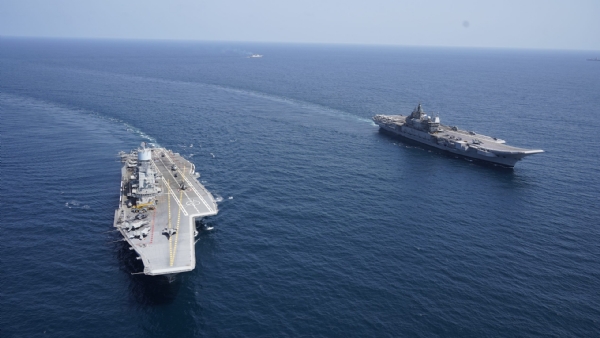
Rajnath Singh to witnesses twin aircraft carrier operations on 1st day of naval commanders' conclave
 
 
Defence Minister Rajnath Singh and top Indian Navy commanders reviewed maritime security challenges during a conference onboard one of the Navy's aircraft carriers in the Arabian Sea. Discussions included China's military presence in the Indian Ocean and the targeting of cargo vessels by Houthi militants. The conference focused on enhancing tri-service synergy and readiness in defence of India's national interests.
 
 
India cannot afford to remain dependent on defence imports: Rajnath Singh
 
 
India's Defence Minister, Rajnath Singh, has stressed the need for India to reduce its dependency on imported military hardware in order to maintain strategic autonomy. Singh highlighted the Modi government's focus on boosting domestic manufacturing and stated that the annual volume of domestic defence production has surpassed Rs 1 lakh crore, compared to around Rs 44,000 crore in 2014.
 
 
Navy commissions strategically important base INS Jatayu in Lakshadweep Islands
 
 
The Indian Navy commissioned INS Jatayu at Minicoy island, enhancing its operational capabilities in the strategically important Lakshadweep islands. The new base will support anti-piracy and anti-narcotics operations. The naming of INS Jatayu recognizes the spirit of service before self.
 
 
Women Commandos: Catalysts for change, guardians of peace in India's red corridor
 
 
The Danteshwari Fighters, the first all-woman anti-Maoist commando unit in Bastar, has evolved from an experiment to a formidable force, with two members recently awarded promotions for their gallantry. These 97-strong volunteers are willing to risk their lives to protect their comrades and communities. Similarly, in Maharashtra's Gadchiroli district, 11 women officers are stationed at a critical outpost, ready to combat Maoist insurgents. Both units, composed of passionate and dedicated women, are making significant strides in the fight against Maoist violence.
 
 
JCO kidnapped in Manipur, fourth such incident since conflict began
 
 
A Junior Commissioned Officer (JCO) of the Army, Konsam Kheda Singh, was kidnapped from his home in Manipur's Thoubal district by unknown individuals, marking the fourth such incident since the conflict in Manipur began. The reason for the abduction is not yet known, but it is suspected to be related to extortion. Security agencies have initiated a coordinated search operation to rescue the JCO, conducting checks on vehicles along National Highway 102.
 
 
Big gain for IAF: Govt clears next-gen fighter prototypes and development
 
 
The government has approved the development and prototype production of next-generation fighters for the air force, aiming to bolster the domestic manufacturing ecosystem and enhance the armed forces' combat capabilities. The Cabinet Committee on Security (CCS) greenlit the estimated Rs 15,000 crore proposal, advancing the project to the prototype production stage. The Advanced Multirole Combat Aircraft (AMCA), a fifth-generation fighter jet, is slated to take flight by 2028, featuring cutting-edge technologies like stealth capabilities, AI integration, long-range targeting, and compatibility with unmanned systems.
 

Sunday, 3 March 2024

COUNTERING SECURITY CHALLENGES 04 MAR 24

 Milan 2024: War exercise including 50 Navies kicks off in Vizag


Milan 2024, the Indian Navy's biggest multilateral naval exercise, has begun in Vizag. The Harbour Phase, from February 19 to 23, features a city parade, maritime seminar, tech expo, and various events. The Sea Phase, from February 24 to 27, includes air defence, anti-submarine, and anti-surface warfare drills. INS Vikrant, INS Vikramaditya, and other warships will be showcased. Traffic restrictions are in place, with heavy vehicle movement limited in specific areas.
 
 
IAF displays firepower in Exercise Vayu Shakti with Rafale, LCH Prachand among 120 aircraft
 
 
The Pokhran range close to the India-Pakistan border in Rajasthan's Jaisalmer on Saturday witnessed the Indian Air Force's full spectrum display of combat and fire capabilities as part of its Exercise Vayu Shakti-2024. Over 120 aircraft of the IAF, including Rafale, Su-30 MKI, MiG-29, Mirage-2000, Tejas, C-17 and C-130J, took part in the exercise, keeping with the tagline 'lightning strike from the sky.
 
 
IAF's Sukhoi fighter jets to get a Rs 60,000 crore booster: Here are all the upgrades for the new Su-30MKI
 
 
The Defence Ministry has approved a Rs 60,000 crore upgrade of India's Su-30MKI fighter jet fleet, led by HAL and supported by DRDO. This project aims to enhance the aircraft's capabilities with new radars, mission control systems, and weapon systems, reflecting India's push for self-reliance in defence manufacturing. The upgrade will include the integration of indigenous systems, such as a new radar system and electronic warfare capabilities, improving air-to-air and air-to-ground targeting.
 
The mainstay Su 30MKI fighter jet fleet is set to undergo a comprehensive upgrade worth ₹60,000 crore. The upgrade will include new radars, mission control systems, electronic warfare capabilities, and integration of new weapon systems. Hindustan Aeronautics Limited, with support from DRDO, will lead the upgrade with heavy participation from the private sector.
 
 
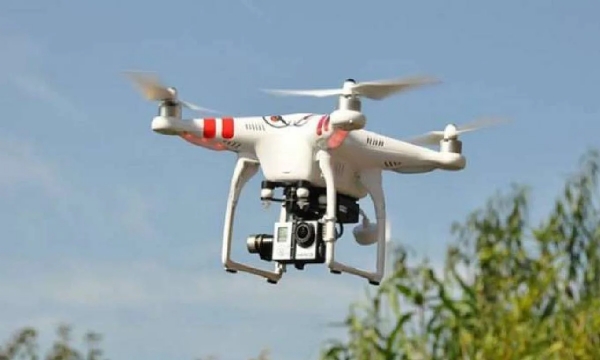
How India Can Become a Drone Hub
 

NB Security Scan 76 
 
 
“India is in the process of acquiring 31 higher-end MQ9B Predator armed drones from the United States at an approximate cost of Rs 2.5 lakh crore. The deal was announced during Prime Minister Narendra Modi’s visit to the US in 2023. The Navy already operates two unarmed Predator drones, which are on lease, at the Rajali naval air station in Tamil Nadu. The new acquisitions will be apportioned to the three Services with the Navy getting the majority share. Apart from the political message of reliance on the US for major weapon systems, it also signals that Atmanirbharta is not currently feasible in this class of weapon systems.”
 
How exactly do we go about getting our drones infra in place? If more indigenous products are going to be developed, the government will also have to increase its budget to procure the items on offer. The interim defence budget allocation and the government’s allocation for capital expenditure do not indicate any steps to meet that need. Statistical jugglery apart, when one takes inflation and changes in foreign exchange rates into account, the capital budget will fall short on the demand side. Until now, the structural problem has mostly been on the supply side.
 
 
Govt creates about 24K deputation reserve pool in central armed police forces, Assam Rifles
 
 
The Union government has sanctioned the creation of a 24,000-personnel deputation reserve within the existing manpower of the five central armed police forces and Assam Rifles. The Ministry of Home Affairs (MHA) issued an order for the creation of a 23,958 'deputation reserve' in the CRPF, BSF, ITBP, CISF, SSB, and Assam Rifles. These forces are deployed for various internal security duties, including counter-terrorist operations, border guarding, elections, and maintaining law and order.
 
 
India's first spy satellite made by local private player set for SpaceX liftoff
 
 
India's first military grade spy satellite, manufactured by the domestic private sector, is ready and has been shipped for launch on a SpaceX rocket. The ground control in Bengaluru will direct the satellite's path and process imagery. It will provide imagery with 0.5-metre spatial resolution. The satellite has been built in partnership with Satellogic.
 

Countering INDIAN External & Internal Security Challenges


India Army Raising 18 Corps to strengthen its posture in Cenral Command on Chinese border
 
 
Despite efforts to maintain stability, recent deployments of substantial military assets by both India and China have underscored the sensitivity of the LAC.
 
In a strategic move, India has redirected attention to the eastern front, particularly its border with China. However, recent developments have prompted a reassessment of priorities, with a shift towards addressing security challenges along the LAC with China.
 
The Indian Army's response involves a major restructuring effort, converting an area headquarters into a corps headquarters, indicating a significant upgrade in military capabilities. The Bareilly headquarters, known as Headquarters Uttar Bharat, has been reinforced with three brigades and an infantry division, reflecting India's commitment to enhancing defense capabilities in the region.
 
This transformation includes elevating the Bareilly headquarters into a fully functional corps, with the proposed 18 Corps anticipated to comprise three divisions and potentially up to 45,000 soldiers. This strategic realignment demonstrates India’s proactive approach to address security challenges posed by China along the disputed border.
 
India remains vigilant, recognizing the strategic significance of the LAC in its broader geopolitical context. As India emerges as a prominent economic power, it faces increasing pressure and scrutiny from China.
 
 
Indian Army plans Rs 57,000 crore project to replace 1,800 aging Russian T-72 tanks with advanced AI battle machine
 
 
The Indian Army, with 12 lakh personnel, is gearing up to upgrade its tanks and introduce new ones, in response to reports on tank vulnerabilities. Senior officers attribute the heavy losses of Russian tanks in Ukraine to poor tactics, highlighting the need for combined-arms operations. A mega project worth Rs 57,000 crores aims to produce 1,770 Future Ready Combat Vehicles (FRCVs) to replace old T-72 tanks, starting in 2030. These FRCVs will feature advanced technologies like AI, drone integration, and active protection systems.
 
 
Lt Gen Upendra Dwivedi assumes charge as Vice Chief of Army Staff
 
 
Lieutenant General Upendra Dwivedi has taken over as the new Vice Chief of Army Staff, succeeding Lieutenant General MV Suchindra Kumar. Previously serving as the Northern Army Commander, Lt. Gen. Dwivedi is now positioned as the potential candidate to assume the role of Army Chief after General Manoj Pande's retirement on May 31. He paid his respects to fallen soldiers at the National War Memorial and received a guard of honor before assuming his new responsibilities.
 
 
Indian Navy to carry out major twin aircraft carrier operations off west coast in March
 

NB Security Scan 76 
 
 
The Indian Navy is going to carry out major operations involving the fleets of both of its aircraft carriers off the west coast in the next ten days, Admiral R Hari Kumar said on Sunday.
 
 
Navy clears deal for 31 Predator Drones from US, contract signing expected in coming months
 
 
Navy chief Admiral R Hari Kumar has announced that the Defence Acquisition Council has approved the purchase of 31 Predator drones from the US, with a contract signing expected in the coming months. The deal, valued at approximately USD 4 billion, will see 15 drones operated by the Indian Navy, while the Army and Air Force will operate 8 each. This procurement is part of India's efforts to bolster its maritime capabilities and protect national interests.
 
 
Chief of Naval staff R Hari Kumar inaugurates Nibe Defence and Aerospace Ltd
 
 
Admiral R Hari Kumar, Chief of Naval Staff, inaugurated the new manufacturing plant of Nibe Defence and Aerospace Limited in Pune, emphasizing the Indian Navy's role in promoting self-reliance in defence production. The event highlighted Nibe's contributions to various defence projects and the importance of advanced equipment in achieving self-reliance. The inauguration also included announcements about upcoming naval operations, showcasing the navy's capabilities and preparedness.