
The function at Bithur highlighted the exceptional leadership demonstrated by Nana Saheb during the 1857–58 India"s First War of Independence.
Shri Shivaji Raigad Smarak Mandal, Ved Vasudev Foundation, Itihas Premi Mandal Pune, Thorle Bajirao Peshwa Pratishthan Pune, along with several organizations from Uttar Pradesh and the Government of Uttar Pradesh, jointly celebrated the 200th birth anniversary of the legendary military leader Nana Saheb II. The event took place at Nana Saheb Peshwa Park in Bithur, near Kanpur, Uttar Pradesh, from March 28 to March 30, 2025.
The entire event was coordinated by Shri Sudhir Thorat, Secretary of Shri Shivaji Raigad Smarak Mandal. The function at Bithur highlighted the exceptional leadership demonstrated by Nana Saheb during the 1857–58 India's First War of Independence.
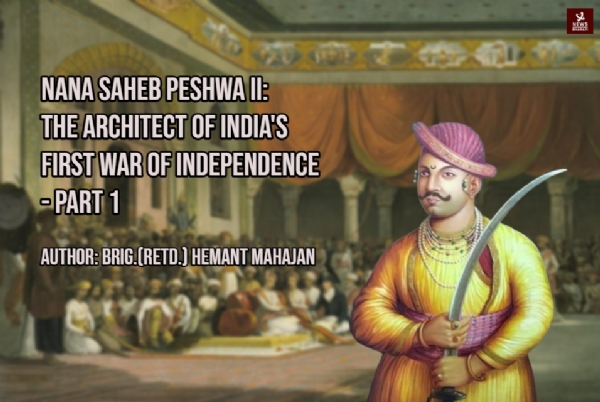
Nana Saheb Peshwa II (19 May 1824 – after 1857), born as Dhondu Pant, was an Indian military leader who played a crucial role in the Indian War of Independence of 1857. He led the Siege of Cawnpore (Kanpur) against the British East India Company.
Following the defeat of the Marathas in the Third Anglo-Maratha War, the British exiled Peshwa Baji Rao II to Bithoor (near Kanpur) but allowed him to maintain a substantial household, partly funded by a British pension. Nana Saheb’s father, a well-educated Deccani Brahmin, relocated from the Western Ghats to serve as a court official for the exiled Peshwa. He later married the sister of one of the Peshwa’s wives, and they had two sons.
Since Baji Rao II had no biological sons, he adopted Nana Saheb and his younger brother, Bala Saheb, in 1827. Nana Saheb grew up alongside prominent historical figures such as Tatya Tope, Azimullah Khan, and Manikarnika Tambe, the future Rani of Jhansi. Tatya Tope, a skilled warrior, served as Nana Saheb’s fencing master, while Azimullah Khan later became his secretary and dewan.
Denial of Inheritance and the Doctrine of Lapse
The East India Company of the British Empire began to expand. The mighty Maratha Empire was finally destroyed in 1818, and states like Bengal, Orissa, Hyderabad and Mysore were also annexed. The British flag was hoisted at Shaniwarwada in Pune.
The British East India Company exercised absolute administrative control over many regions of India and implemented an annexation policy known as the Doctrine of Lapse under Governor-General Lord Dalhousie (1848–1856). This policy allowed the British to annex any princely state if its ruler was deemed "manifestly incompetent" or died without a direct heir. The doctrine ignored the long-standing Indian tradition that allowed rulers to adopt successors, creating widespread resentment.
Although the Peshwa's territories had already been annexed in 1818, before the doctrine was formalized, the British used it to deny Nana Saheb the pension granted to Baji Rao II, as he was an adopted son. Under British rule, Baji Rao II had received an annual pension of 800,000 rupees (£80,000 at the time) and tax-free land grants. However, upon his death, these privileges were revoked.
Nana Saheb made several appeals to the British authorities for the restoration of his pension and estates, but all his efforts were rejected. Frustrated by these repeated failures, he sent his trusted advisor, Azimullah Khan, to London to argue his case before the British government. However, the mission ended in failure, further fueling Nana Saheb’s discontent against British rule.
The following aspects will be covered in this article:-
- Nana Saheb's Role Before the Uprising
- The Outbreak of the War of Independence in Kanpur
- The Consecration of Nana Saheb, British Forces Advance on Kanpur
- Further Battles and British Gains
- Nana Sahib's Escape and British Pursuit, Battle of Bithur and Rebel Counterattacks
- Tatya Tope’s Attempt to Recapture Kanpur
- British Counteroffensive and the Final Defeat of the Rebels
- Contributions to the 1857 War of Independence and Effect on History
- Conflicting Accounts of Death, Aftermath of the Events of 1857
- Inspiring Uprising All Over India, Military Strategy and Conduct
- The Challenge: A Divided India vs a Powerful British Empire
- Nana Saheb’s Legacy in Independent India
- Role in the 1857 War of Independence
When the Indian War of Independence of 1857 erupted, Nana Saheb emerged as a key leader in Kanpur. He assumed command of the rebel forces and laid siege to the British garrison stationed there. After forcing the British troops to surrender, he ordered the execution of the surviving captives, briefly taking control of Kanpur.
Nana Saheb's Role Before the Uprising
Bithoor, located 13 miles northwest of Kanpur, was Nana Saheb’s residence, where he lived in a well-furnished palace inherited from his adoptive father, Peshwa Baji Rao II. He was known for his generosity and frequently hosted British officers earning their trust and goodwill.
In April 1857, Nana Saheb embarked on a tour of nearby cantonments, ostensibly on a pilgrimage. He was warmly received in Lucknow by Sir Henry Lawrence but abruptly cut short his visit and returned to Kanpur. Major General Hugh Massey Wheeler, commander of British forces in Kanpur, trusted Nana Saheb.
Despite reports that Nana was hosting disbanded soldiers from the 19th Native Infantry passing through Bithoor in late April, General Wheeler dismissed any concerns. By May, signs of unrest, including arson attacks, had begun appearing in Kanpur. Several Indians, warned the British about Nana Saheb’s suspected intentions, but the British continued to trust him. He was even invited to participate in discussions regarding the defense of the British cantonments.


No comments:
Post a Comment