
https://www.newsbharati.com/Encyc/2025/4/15/Illegal-Bangladeshi.html
Amit Shah cited the illegal acquisition of Aadhaar and voter identity cards by Bangladeshi nationals, who are posing as Indian citizens.
Total Views | 225
Border Security Concerns: Shah Accuses West Bengal of Border Fencing Delays-30 March 2025
Union Home Minister Amit Shah stated in the Lok Sabha that approximately 450 kilometers of the India-Bangladesh border remain unfenced, attributing the delay to the Trinamool Congress government's "appeasement politics," which facilitates illegal migration. He emphasized that repeated communications with the West Bengal government regarding land acquisition for fencing have yielded minimal progress. Shah cited the illegal acquisition of Aadhaar and voter identity cards by Bangladeshi nationals, who are posing as Indian citizens.
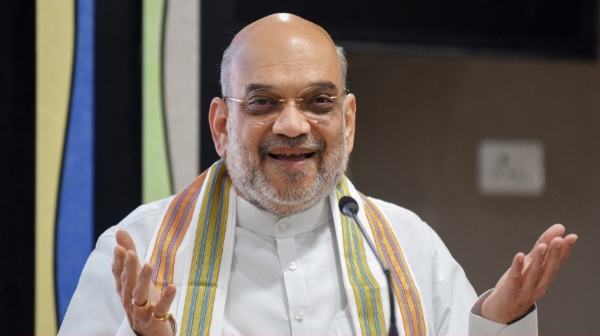
Trinamool Congress Chief Minister Mamata Banerjee and Jammu and Kashmir Chief Minister Omar Abdullah have made great efforts to grant Indian citizenship to Bangladeshi and Pakistani nationals respectively for political reasons. It was very difficult to declare them as foreign nationals after providing them with documents like ration cards, Aadhaar cards and voter ID cards. It is estimated that there are around ten crore illegal immigrants living in India today. Unfortunately, identifying them and sending them back to their home countries is not as easy as it is in the US. This is because of the electoral politics of the opposition parties in India; this is an unfortunate truth. Amit Shah mentioned this in detail in his speech.
5,000 Bangladeshi individuals living in Borivali
Borivali's Member of the Legislative Assembly, Shri Sanjay Upadhyay, stated on March 30th that he has identified more than 5,000 Bangladeshi individuals living within his constituency. He reports they are working on various projects managed by the Mumbai Municipal Corporation, like road repairs and building construction, and also in roles such as street vendors and domestic workers. He alleges their large numbers have taken over street shopping in Borivali and occupied railway platforms. Additionally, he claims they have constructed six-story slums near the railway station. He asserts that the Mumbai Municipal Corporation is ignoring the presence of these illegal migrants, many of whom he describes as aggressive and having seized trade opportunities from local shopkeepers.
BJP leader Kirit Somaiya had brought forward the information that 181 Bangladeshis in Nashik district had taken advantage of the 'Pradhan Mantri Kisan Samman Nidhi' scheme. Meanwhile, a case has now been registered against these Bangladeshis on Wednesday, March 26.
Addressing Illegal Bangladeshi Migration in the Hinterland -Few Recommendations
1. Secrecy is Key
Efforts to apprehend illegal Bangladeshi migrants must remain confidential to prevent them from fleeing to other states. Publicizing such operations can undermine their effectiveness, as it alerts the migrants and their support networks.
2. Identifying Illegal Migrants
Many migrants falsely claim to be from West Bengal or the northeastern states, but verifying their origins as Bangladeshi is straightforward with proper investigation. While some possess Indian government-issued documents like Aadhaar and PAN cards, others either lack documentation or rely on forged papers.
3. Involving the Community
Common citizens can act as the "eyes and ears" of law enforcement by reporting suspected illegal migrants. However, they must be assured that their identities will remain confidential to encourage participation. Local organizations working in this domain can also assist in detection efforts.
4. Challenges Faced by Law Enforcement In the states
Police stations tasked with detecting illegal migrants face several hurdles:
Understaffing: Only 2-3 investigating officers (IOs) are typically available per police station.
Judicial Delays: The legal process is time-consuming, requiring frequent court appearances that drain police resources.
Limited Punishment: Convicted migrants often receive light sentences (e.g., one year), after which they are handed over to the Border Security Force (BSF) for deportation. Bureaucratic hurdles further complicate this process.
5. Recommended Solutions
a. Increase Investigative Capacity
Deploy 10-15 dedicated IOs per police station in major cities, drawing from the pool of over 3 lakh retired policemen in each affected state. These experienced officers can significantly improve detection efforts.
b. Judicial Reforms
Establish fast-track courts or tribunals to expedite cases within 7-10 days.
Conduct in-camera trials to minimize the strain on police resources.
Eliminate the option of bail for arrested migrants.
c. Secure Detention Facilities
Hold all detained migrants in designated, secure camps during their trials to prevent escape.
d. Target the Support Networks
Arrest agents and individuals who assist migrants in obtaining fake documents and employment.
Punish locals who harbour or employ illegal migrants.
e. Digitize Data
Create a centralized digital database to streamline investigations across police stations.
f. Leverage Local Expertise
Assign Bengali-speaking personnel to police stations to assist in identifying migrants. Their identities must be protected for safety.
Form specialized teams comprising IOs, intelligence officers, Bengali-speaking experts, and locals with area knowledge.
g. Incentives and Rewards
Provide monetary or job-related incentives to officers and citizens contributing to the detection of illegal migrants.
Offer roles in the Home Guards or similar positions to locals providing reliable intelligence.
6 . Maintaining Operational Confidentiality
To ensure success, all activities related to the detection and deportation of illegal migrants must remain confidential. Press briefings or public disclosures should be avoided to prevent migrants from escaping to other states.
By addressing these challenges with a comprehensive and covert strategy, Maharashtra can effectively tackle the issue of illegal Bangladeshi migration while maintaining public order and national security.


No comments:
Post a Comment